Technology
Is 5G Home Internet a Viable Replacement for Cable Broadband?
For decades, the residential broadband market in the United States operated under an entrenched regional monopoly. In most suburban and urban neighborhoods, subscribing to high-speed internet meant dealing with a single dominant cable provider. Consumers grew accustomed to a familiar cycle: attractive twelve-month introductory pricing, followed by steep automatic rate hikes, mandatory hardware rental fees, confusing line-item surcharges, and customer service departments infamous for friction.
The rapid expansion of 5G home internet, technically classified as Fixed Wireless Access, has disrupted this dynamic. Instead of relying on a physical line dropped from an exterior utility pole into your living room, these systems beam connectivity over the air directly from local cellular base stations into a compact indoor gateway. With major cellular carriers offering flat monthly rates, equipment included, and no long-term contracts, millions of households are asking whether it is finally time to cut the physical cord completely.
The answer is not a simple yes or no. Whether wireless home internet can genuinely replace your existing coaxial cable connection depends on your home physical geography, how your household utilizes bandwidth, and your tolerance for the natural variability of radio waves.
How 5G Home Internet Operates Under the Hood
To evaluate fixed wireless fairly, you have to look past the marketing and understand the physical delivery mechanism. Mobile 5G on a smartphone is designed for mobility across shifting locations. Fixed wireless access, by contrast, relies on a dedicated terminal installed at a permanent address, utilizing directional antenna arrays specifically tuned to maintain a stable, high-capacity link with a nearby cell tower.
The performance of your connection is dictated almost entirely by the specific radio spectrum frequencies reaching your home:
Low-band frequencies travel great distances and penetrate exterior walls with ease, but they offer modest speeds that rarely outshine entry-level cable packages.
Mid-band spectrum, often called C-band, serves as the practical backbone for most residential deployments across the country. It strikes an effective balance, penetrating typical residential construction while delivering download speeds ranging anywhere from 100 to 300 megabits per second, with occasional spikes well beyond that under ideal conditions.
High-band millimeter wave (mmWave) delivers breathtaking throughput that can easily eclipse a gigabit per second. However, millimeter wave signals have an extremely limited physical range and struggle to penetrate dense obstacles like double-pane low-emissivity glass, brick veneers, or dense summer foliage. Unless you have an unobstructed line of sight to a node located just down the block, your connection will almost certainly rely on mid-band frequencies.
Cable Broadband’s Enduring Architectural Strengths
While traditional cable providers carry a reputation for frustrating customer service, their physical network infrastructure remains exceptionally robust. Most cable networks operate on hybrid fiber-coaxial architecture using advanced DOCSIS signaling standards.
The primary advantage of cable is physical isolation. A copper coaxial line shielded in heavy jacketing and buried underground is completely immune to shifting weather patterns, heavy downpours, windstorms, and physical terrain barriers. It delivers a protected stream of data directly from the neighborhood fiber node to your modem.
Because of this physical medium, cable networks offer consistent, predictable throughput. If you subscribe to a 400 Mbps or 1,000 Mbps cable tier, your connection will generally hover near those numbers day in and day out, regardless of whether your neighbors are streaming movies or your trees are in full bloom. For households with immense bandwidth demands, the raw speed ceiling of cable remains significantly higher than what average wireless setups can provide.
The Real-World Performance Faceoff
Evaluating internet service on paper is easy; living with it daily is another matter. When comparing 5G home internet to coaxial cable, performance differences emerge in specific operational categories.
Download Speeds vs. Real Household Demands
On pure paper specs, cable wins the top-end speed contest hands down. Gigabit and multi-gigabit cable plans are commonplace in major metropolitan regions, while 5G fixed wireless typically delivers real-world downloads somewhere between 75 and 300 Mbps.
What many consumers overlook, however, is that most homes do not come close to saturating a gigabit pipeline. Streaming an ultra-high-definition 4K movie uses roughly 15 to 25 Mbps of bandwidth. A high-definition corporate video call requires less than 5 Mbps. Even if four family members are simultaneously streaming 4K video while two others browse social feeds, total household demand rarely exceeds 120 Mbps.
Where high-speed cable truly pulls ahead is in handling massive, discrete file transfers. If your household regularly downloads 100-gigabyte modern video game updates or works with massive raw media files, the extra headroom of a 500 Mbps or 1,000 Mbps cable tier will save you noticeable chunks of time. For routine daily browsing, streaming, and remote office tasks, a healthy mid-band 5G connection feels indistinguishable from cable.
The Latency and Jitter Divide
Speed measures how much data can travel across your pipe in a second; latency measures how quickly a single packet of data makes a round trip between your device and a remote server. This is where the physical advantage of a wired connection becomes undeniable.
A standard cable connection typically exhibits low, stable ping times between 12 and 25 milliseconds, accompanied by minimal jitter. Fixed wireless, having to navigate atmospheric conditions and wireless transmission layers, generally runs at latency figures between 35 and 70 milliseconds, frequently punctuated by brief spikes.
For web browsing, email, streaming entertainment, and typical cloud office tools, a 40-millisecond difference is imperceptible. But for competitive online gaming, real-time stock trading platforms, or latency-sensitive remote desktop applications, high or volatile latency causes noticeable stutter, input lag, and packet loss. If competitive gaming is a major priority in your home, cutting the cable line is often a downgrade.
Cellular Congestion and Deprioritization
Cable networks can suffer from neighborhood congestion during peak evening viewing hours if a local node is oversubscribed, but cellular networks face a far more dynamic allocation challenge.
Wireless spectrum is a finite shared resource. Cellular carriers prioritize mobile phone traffic on their towers to ensure standard voice and mobile data services remain flawless. During peak commute hours or large public gatherings nearby, home internet traffic is typically the first to be deprioritized.
This means a 5G home internet user might clock a brisk 250 Mbps at eleven in the morning, only to watch that figure drop to 40 or 50 Mbps around eight o’clock in the evening. While 50 Mbps remains plenty of bandwidth for multiple video streams, the inconsistency can frustrate users who expect a flat, unwavering connection around the clock.
Economics, Contracts, and Customer Freedom
The technology tells one half of the story; the billing ledger tells the other. The immense popularity of 5G home internet is driven primarily by consumer exhaustion with cable billing practices.
5G carriers have structured their home offerings with radical commercial simplicity. They generally offer flat, predictable monthly pricing with taxes and equipment rentals built straight into the headline figure. There are no contracts, no early termination penalties, and no arbitrary price hikes after six or twelve months.
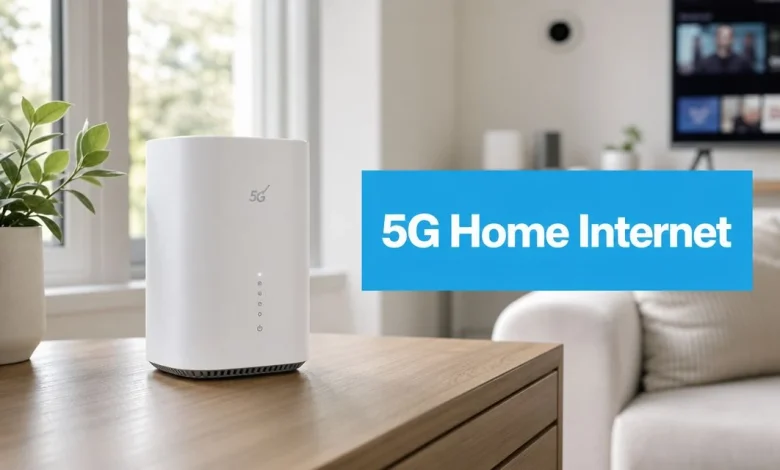
Setup is entirely self-directed: you unbox a sleek white cylinder, plug it into an electrical outlet near an exterior window, pair it via a smartphone app, and your network is online in under ten minutes. No drilling through brick walls, no waiting around for an installer during a four-hour appointment window, and no activation fees.
Traditional cable providers have spent years alienating customers through defensive pricing strategies. Equipment rental fees for modems and gateway routers often tack on an extra fifteen dollars every single month. Many cable packages still enforce monthly data caps, typically set around 1.2 terabytes, charging punitive overage fees unless customers pay extra for unlimited tiers. When introductory promotional periods expire, bills can spike by forty percent overnight, forcing subscribers into the ritual dance of calling retention departments to negotiate a new rate.
The simplicity of 5G fixed wireless has forced many cable providers to re-examine their policies, but wireless operators still hold the moral and operational high ground when it comes to consumer transparency.
Evaluating Your Household: Who Should Switch and Who Should Stay
Choosing between these two technologies requires looking honestly at your household digital habits and physical location.
Switching to 5G home internet makes immediate sense if you:
-
Live in a single-family home or apartment with strong, unobstructed line of sight to a nearby mid-band cellular tower.
-
Are a moderate household of one to four people whose primary online activities consist of streaming entertainment, casual web surfing, and remote work meetings.
-
Are tired of annual cable price negotiations, hidden equipment fees, and restrictive data usage caps.
-
Rent your home or relocate frequently and want connectivity that packs into a box and moves with you without administrative hurdles.
Staying with cable broadband is the wiser choice if you:
-
Have one or more serious online gamers in the home who require rock-bottom ping times and zero packet loss.
-
Work with massive digital creative assets, such as high-resolution video production or extensive local server backups, where gigabit download speeds and higher upload capacity are non-negotiable.
-
Live in a valley, heavily wooded acreage, or dense concrete structure where cellular reception is historically weak or inconsistent.
-
Already receive a reliable, reasonably priced standalone cable plan with no data caps and no expiring promotions.
The Changing Reality of Home Connectivity
The emergence of 5G home internet marks a fundamental shift in residential telecommunications. For the first time in modern internet history, a wireless solution offers sufficient bandwidth, acceptable reliability, and consumer-friendly pricing capable of challenging the coaxial cable monopoly on its own turf.
While it does not yet match the ultra-low latency or the gigabit ceilings of well-maintained wired networks, it does not need to. For the vast majority of everyday consumers, 5G fixed wireless delivers more than enough raw performance to power modern digital life, paired with a transparent billing model that respects the consumer. As cellular network density improves and mid-band coverage expands, wireless broadband is no longer just a clever temporary workaround; for millions of households, it has become a fully viable, permanent replacement.